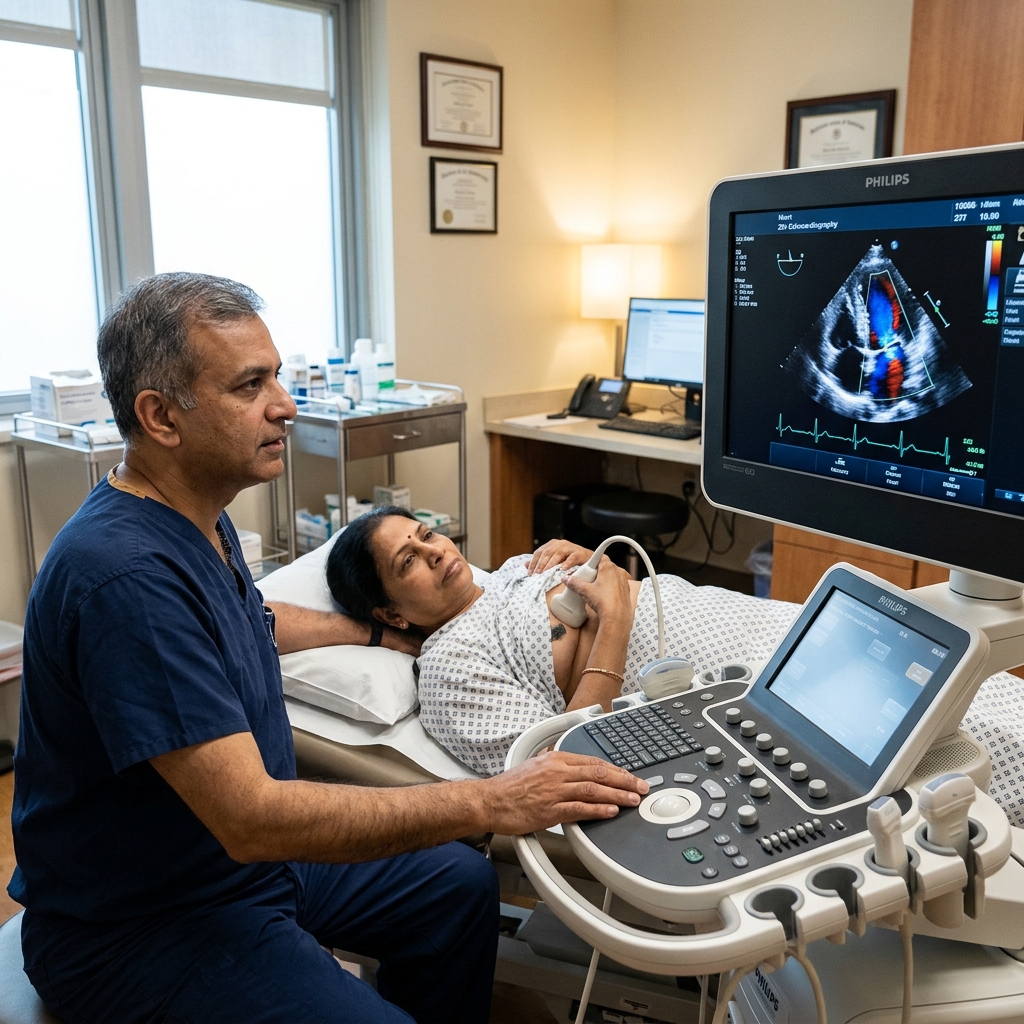
2D Echocardiography with Colour Doppler
A 2D echocardiogram uses high-frequency sound waves to produce real-time moving images of your heart — showing the four chambers, four valves, pumping muscle, and surrounding pericardium. The test's central purpose is to assess left ventricular function: how forcefully your heart contracts and how well it relaxes between beats. Colour Doppler simultaneously maps blood flow through the heart, detecting valve leakage, stenosis, and abnormal pressures. It is the single most informative non-invasive cardiac test — and its findings directly guide your treatment — without any radiation. The result is available the same day and reviewed directly by Dr. Amit Singh, FACC.
What Is Echocardiography — And What Does It Look At?
Echocardiography uses ultrasound to visualise the heart and its structures.
Echocardiography is the umbrella term for any cardiac imaging technique that uses ultrasound — high-frequency sound waves — to visualise the heart. A transthoracic echocardiogram (TTE) is the standard, most common form of echocardiography, performed by placing a probe on the chest wall from outside the body. 2D Echocardiography with Colour Doppler is built on this TTE platform, combining real-time two-dimensional imaging with Colour Doppler flow mapping in a single study. This page covers the standard TTE with Colour Doppler. Two related but distinct tests exist for specific situations: the transoesophageal echocardiogram (TOE), which uses a probe passed via the oesophagus for higher-resolution images of specific structures, and the stress echocardiogram, which compares wall motion at rest and under exercise or pharmacological stress to detect coronary artery disease. Each requires its own preparation and serves a different clinical question. Before interpreting what the test detects, it helps to have a working knowledge of cardiac anatomy — the structures the test images. The heart has four chambers — the right and left atria (the receiving chambers) and the right and left ventricles (the pumping chambers) — separated by four valves: the mitral and tricuspid valves, which sit between the atria and ventricles, and the aortic and pulmonary valves, which guard the exits to the body and lungs. The entire heart sits within a thin fibrous sac called the pericardium. A complete 2D Echocardiography with Colour Doppler study images all four chambers, all four valves, the great vessels at their origins, and the pericardial sac — a comprehensive structural survey of the heart in a single session.
How Colour Doppler Sees Blood Flow
Doppler ultrasound converts moving blood into a real-time flow map.
Colour Doppler works on the principle of Doppler ultrasound: sound waves reflected from moving red blood cells return to the probe at a slightly different frequency than they were sent — a phenomenon called the Doppler shift. The direction and magnitude of this frequency shift encode both the speed and the direction of blood flow. The echocardiography machine translates this shift in real time into a colour-coded map overlaid on the 2D image — conventionally, red indicates flow moving toward the probe, and blue indicates flow moving away. Colour Doppler is systematically applied across all four cardiac valves, with the mitral and aortic valves receiving particular clinical scrutiny because disease at these two valves is both more common and more consequential. Turbulent, high-velocity, or reversed flow signals at a valve indicate stenosis (narrowing) or regurgitation (leakage) — abnormalities that would be completely invisible on 2D imaging alone. This is what makes Colour Doppler indispensable for diagnosing and grading valvular heart disease.
What Does an Echocardiogram Show?
A 2D echocardiogram with Colour Doppler provides a comprehensive real-time assessment of the heart's structural and functional status.
The test's primary task is to assess left ventricular function — both how forcefully the left ventricle contracts (systolic function) and how well it relaxes and fills between beats (diastolic function). Ejection fraction (EF) is the number that captures the systolic half of this assessment in a single reproducible figure: it expresses, as a percentage, how much blood the left ventricle ejects with each beat. It is this figure — above or below specific guideline thresholds — that determines whether a patient's heart failure is classified as reduced, mildly reduced, or preserved ejection fraction. Colour Doppler complements this by measuring blood flow velocity and direction through each valve, detecting leakage (regurgitation) and narrowing (stenosis) with quantitative precision.
Ejection Fraction — The Most Important Number
EF classification connects an echo finding to its treatment pathway.
| EF Range | Classification | Treatment Pathway |
|---|---|---|
| ≥50% | Normal / HFpEF* | Normal pump function. *If symptomatic with normal EF — see Diastolic Dysfunction below. |
| 40–49% | HFmrEF | Heart failure, mildly reduced EF. GDMT considered, individualised to trajectory. |
| <40% | HFrEF | Heart failure, reduced EF. Quadruple GDMT (ACEi/ARNi, beta-blocker, MRA, SGLT2i). CRT/ICD assessed if criteria met. |
Causes of Cardiac Abnormalities Detected by Echo
Echocardiography reveals structural and functional changes caused by various cardiac conditions.
Coronary Artery Disease
Narrowing of coronary arteries leads to wall motion abnormalities visible on echo. Prior heart attacks produce scar tissue that appears as akinetic or dyskinetic segments.
Hypertension
Long-standing high blood pressure causes left ventricular hypertrophy (LVH), concentric remodelling, and diastolic dysfunction — all readily quantified on echocardiography.
Valvular Heart Disease
Rheumatic heart disease, degenerative calcific stenosis, and myxomatous degeneration cause valve thickening, restricted motion, or prolapse, producing regurgitation or stenosis.
Cardiomyopathy
Dilated, hypertrophic, and restrictive cardiomyopathies produce characteristic echo findings — from dilated thin-walled chambers to asymmetrical septal hypertrophy.
Pericardial Disease
Pericardial effusion, constrictive pericarditis, and pericardial thickening are well-visualised on echo. Tamponade physiology can be identified by chamber collapse.
Congenital Heart Disease
Atrial and ventricular septal defects, patent ductus arteriosus, and other congenital anomalies are identified and quantified on echocardiography from childhood through adulthood.
6 Specialized Ultrasound Modes
A comprehensive echocardiogram combines multiple ultrasound modalities, each providing a different piece of diagnostic information.
| Ultrasound Mode | Clinical Application |
|---|---|
| 2D Imaging | Real-time cross-sectional images — parasternal long-axis, short-axis, apical 4-chamber, 2-chamber views. Measures chamber dimensions, wall thickness, and structural anatomy. |
| Colour Doppler | Maps direction and velocity of blood flow through valves using colour coding (red = toward probe, blue = away). Detects regurgitation and stenotic flow. |
| Pulsed Wave Doppler | Measures flow velocities at a specific location. Mitral inflow pattern (E/A ratio) and pulmonary venous flow are critical for diastolic function assessment. |
| Continuous Wave Doppler | Measures high-velocity flows across stenotic valves. Calculates peak and mean pressure gradients across the aortic valve for stenosis severity grading. |
| Tissue Doppler (TDI) | Measures myocardial velocities at the mitral annulus (e'). The E/e' ratio is the primary non-invasive estimate of left atrial filling pressure. |
| M-Mode | One-dimensional scan over time for precise measurement of wall thickness (IVST, PWT) and chamber dimensions (LVEDD, LVESD). Calculates EF by Teicholz method. |
Diastolic Dysfunction & HFpEF
A normal ejection fraction does not rule out heart failure.
Left ventricular function encompasses more than how forcefully the heart contracts. When the ventricle stiffens and fails to relax normally between beats — a pattern called diastolic dysfunction — ejection fraction may remain completely normal, yet the patient still develops heart failure with preserved ejection fraction (HFpEF). This is one of the most important, and most commonly missed, diagnoses in cardiology — because a normal EF is often, incorrectly, taken to mean a normal heart. 2D Echocardiography with Colour Doppler detects diastolic dysfunction through specific Doppler flow patterns measured across the mitral valve — principally the E/A ratio (the relative speed of early versus late ventricular filling) and the E/e' ratio (a Tissue Doppler-derived estimate of left atrial filling pressure). An elevated E/e' ratio is the key echo signature that allows your cardiologist to identify HFpEF and distinguish it from HFrEF — a distinction that materially changes the treatment plan.
Wall Motion Abnormalities & Myocardial Ischaemia
Regional wall motion adds coronary-territory information beyond the global EF.
Beyond the global EF figure, 2D imaging assesses each of the standard left ventricular wall segments individually. When 2D imaging reveals a regional wall motion abnormality — a segment of the left ventricular wall that hypokineses (moves weakly), akineses (does not move), or moves paradoxically — the finding is the echocardiographic hallmark of myocardial ischaemia or prior infarction in that territory. Because each LV segment corresponds to a specific coronary artery, the distribution of wall motion abnormalities can help localise the culprit vessel — for example, abnormal motion confined to the anterior wall and septum points toward the left anterior descending (LAD) artery. This relationship is what makes 2D Echocardiography a valuable first-line tool in the workup of chest pain and suspected coronary artery disease.
Pericardial Disease on Echo
Echo findings can identify time-sensitive pericardial disease and valve-driven heart failure.
2D Echocardiography with Colour Doppler can also visualise pericardial disease — conditions affecting the thin fibrous sac surrounding the heart. A pericardial effusion (fluid build-up) appears as a dark, echo-free space surrounding the heart on 2D imaging. In more severe cases, where fluid accumulates rapidly or in large volume, the 2D images can show diastolic collapse of the right ventricle — the hallmark of cardiac tamponade, a haemodynamically critical, time-sensitive finding that demands urgent management. Untreated, severe valvular heart disease — particularly aortic stenosis and mitral regurgitation — is itself a cause of heart failure, as the heart muscle progressively fails under the abnormal pressure or volume load the diseased valve imposes. This is why Colour Doppler grading of valve severity is not just a diagnostic label but a direct driver of the treatment timeline.
Clinical Indications: Who Needs an Echo?
A clinician orders 2D Echocardiography with Colour Doppler in response to specific clinical indications — it is not a screening tool offered to the general population. The test is requested when symptoms such as breathlessness, a newly detected heart murmur, chest pain, or palpitations raise a targeted cardiac question that imaging can answer, or when a known cardiac diagnosis requires structured monitoring.
Breathlessness & Chest Pain
Echo determines if the heart is the cause — assessing EF, diastolic function, valve disease, and pulmonary hypertension in patients presenting with dyspnoea.
Heart Murmur
Identifies which valve is affected, quantifies severity of regurgitation or stenosis, and determines whether surgical intervention is needed.
Heart Failure Suspected
Confirms diagnosis of heart failure, classifies EF (HFrEF, HFmrEF, HFpEF), and guides evidence-based treatment selection.
Post-Heart Attack (Post-MI)
Assesses EF, wall motion abnormalities, and mechanical complications such as VSD, mitral regurgitation, and pericardial effusion after myocardial infarction.
Atrial Fibrillation
Evaluates left atrial size, screens for structural causes, and assesses diastolic function in patients with atrial fibrillation.
Pre-Operative Clearance
Risk stratification before non-cardiac surgery — EF, valve function, and wall motion are assessed to guide perioperative management.
Appointment Preparation & Report Interpretation
A guide on how to prepare for the test and understand the complex numbers in your cardiology report.
Eat and Drink Normally
No fasting required. Continue all medications as prescribed before the echocardiogram.
Wear Comfortable Clothing
Wear a loose, comfortable top. You will need to remove your upper garment and wear a hospital gown for the test.
Positioning During the Test
You will lie on your left side on an examination couch. Occasionally you may be asked to lie on your back or hold your breath briefly.
What You Will Experience
A small amount of gel is applied to your chest — cool at first. The transducer is pressed gently against the chest at multiple positions. You will hear swishing sounds (Doppler signals of blood flow).
Duration and Results
The test takes 20–30 minutes. The result is discussed with you and a written report is prepared the same day.
Risks of Ignoring Echo Abnormalities
Abnormal echocardiographic findings that go unaddressed can lead to irreversible cardiac damage.
Progressive Heart Failure
A reduced ejection fraction (EF <40%) left untreated leads to progressive worsening of pump function, hospitalisations for decompensation, and increased mortality.
Valve Disease Deterioration
Moderate aortic stenosis or mitral regurgitation can progress to severe disease. Delayed intervention results in irreversible ventricular dysfunction and higher surgical risk.
Pulmonary Hypertension
Elevated RVSP on echo indicates pulmonary hypertension. Untreated, this leads to right heart failure, fluid retention, and reduced exercise capacity.
Cardiomyopathy Progression
Undetected or untreated cardiomyopathy — dilated, hypertrophic, or restrictive — progresses to end-stage heart failure, arrhythmias, and sudden cardiac death.
How Your Echo Results Guide Treatment
The clinical workflow begins with a specific indication — breathlessness, a murmur, chest pain, or suspected cardiomyopathy — that prompts your cardiologist to order 2D Echocardiography with Colour Doppler. The findings then feed directly into treatment guidance, determining whether you need medication adjustment, valve intervention, device therapy, or further imaging. The test's findings are not simply descriptive — they are the primary trigger for specific, guideline-defined treatment pathways.
Ejection Fraction Drives Heart Failure Therapy
Ejection fraction is the single most important driver of treatment guidance from this test. EF below 40% places a patient in the HFrEF category, unlocking quadruple guideline-directed medical therapy — ACE inhibitor/ARNi, beta-blocker, mineralocorticoid receptor antagonist, and SGLT2 inhibitor — plus assessment for device therapy (CRT/ICD) if criteria are met. EF 40–49% (HFmrEF) prompts individualised therapy based on trajectory. EF ≥50% with symptoms (HFpEF) shifts management toward blood pressure control, SGLT2 inhibitors, diuretics for congestion, and treating the underlying cause.
Valve Severity Determines Intervention Timing
Valvular heart disease severity grading by Colour Doppler directly determines the timing of intervention. Mild valve disease is typically monitored with serial echocardiography. Severe aortic stenosis or severe mitral regurgitation, once symptomatic or meeting specific echo criteria, becomes an indication for valve repair or replacement — whether surgical or transcatheter (TAVR, MitraClip) — because untreated severe valve disease carries a well-documented mortality risk that intervention reverses.
Serial Echo Monitors Treatment Response
Serial echocardiography — repeating the test at defined intervals — is how your cardiologist monitors whether treatment is working. A rising EF after starting heart failure medication, a stable or improving valve gradient, or resolution of a pericardial effusion are all measured by comparing successive echo studies. Echocardiography is therefore not a one-time test for many cardiac patients, but a recurring tool used throughout the course of their care.
Common Heart Failure & Valve Disease Medications
Echocardiographic findings determine which medication classes are indicated for each patient.
| Condition | Medication Class | Key Considerations |
|---|---|---|
| HFrEF (EF ≤40%) | ACEi/ARNi + Beta-Blocker + MRA + SGLT2i | Quadruple therapy is standard. Start low, titrate to target doses. Monitor potassium and creatinine. |
| HFmrEF (EF 41–49%) | ACEi/ARNi + Beta-Blocker + MRA | Triple therapy recommended. SGLT2i beneficial regardless of EF. Diuretics for congestion. |
| Valvular Heart Disease | Diuretics for symptoms | No medical therapy changes natural history of severe valve disease. Intervention is definitive treatment. |
| Hypertensive LVH | ACEi/ARB + CCB ± Diuretic | Regression of LVH is associated with improved outcomes. ACEi/ARB are preferred for their anti-remodelling effects. |
| Pulmonary Hypertension | Targeted therapy based on PH type | Echo estimates RVSP. Confirmation requires right heart catheterisation before initiating PH-specific therapy. |
Lifestyle for Heart Health
Healthy lifestyle choices complement medical therapy and improve echocardiographic parameters over time.
Heart-Healthy Diet
A Mediterranean diet rich in fruits, vegetables, whole grains, and omega-3 fatty acids supports myocardial function and reduces cardiovascular risk.
Regular Exercise
Moderate aerobic exercise for 150 minutes weekly improves exercise capacity and may slow LV remodelling in heart failure patients.
Weight Management
Obesity increases cardiac workload. Weight loss reduces LV mass, improves diastolic function, and lowers pulmonary pressures.
Smoking Cessation
Smoking accelerates coronary atherosclerosis and impairs myocardial function. Smoking cessation is the single most impactful lifestyle intervention for cardiac health.
Echocardiography Guideline Standards
International guidelines define chamber quantification standards and appropriate use criteria for echocardiography.
| Guideline | Recommendation | Clinical Impact |
|---|---|---|
| ASE/EACVI 2015 | Standardised chamber quantification protocols for LV dimensions, volumes, EF, LA size, and RV function | Ensures consistent measurements across laboratories. EF by biplane Simpson method is the recommended technique. |
| ASE/EACVI 2016 | Diastolic function assessment algorithm using E/e', e' velocity, TR velocity, and LA volume index | Standardises grading of diastolic dysfunction (grades I–III) and estimation of LV filling pressures. |
| AHA/ACC 2020 HF Guidelines | Echocardiography recommended for initial diagnosis and serial assessment of heart failure | EF classification determines GDMT. Repeat echo 3–6 months after therapy change to assess response. |
| ESC/EACTS 2021 Valve Guidelines | Echo severity grading for aortic stenosis (AVA, mean gradient, velocity ratio) and mitral regurgitation (EROA, regurgitant volume) | Severity grading determines intervention timing. Integrated approach using multiple parameters is essential. |
When to See a Cardiologist for an Echo
Certain symptoms and conditions warrant prompt echocardiographic evaluation by a cardiologist.
New or Worsening Breathlessness
Shortness of breath on minimal exertion or at night (orthopnoea, PND) requires urgent echo to assess for heart failure, valve disease, or pulmonary hypertension.
Chest Pain or Tightness
Chest pain — especially if exertional — with a murmur or signs of heart failure requires echocardiography to assess wall motion and valve function.
Heart Murmur on Examination
A new or changing murmur on physical examination warrants echocardiography to determine the cause and severity of the underlying valve lesion.
Known Heart Disease with Symptoms
Patients with known heart failure, valve disease, or prior heart attack who develop new or worsening symptoms need repeat echo to reassess cardiac function.
Frequently Asked Questions
Detailed, peer-reviewed answers to the most common patient concerns regarding echocardiography.
01What is a 2D echocardiogram?
A 2D echocardiogram uses high-frequency sound waves (ultrasound) to produce real-time moving images of the heart's chambers, valves, and pumping muscle. Colour Doppler simultaneously maps blood flow through the valves. Together, these images show how well the heart pumps (ejection fraction), whether the valves are normal, whether the heart walls are moving correctly, and whether pressures are normal — without any radiation or needles. It is the most informative single cardiac test.
02What is left ventricular function and why is it the focus of the test?
Left ventricular function is the central purpose of 2D Echocardiography with Colour Doppler — it describes both how forcefully the left ventricle contracts (systolic function) and how well it relaxes and fills between beats (diastolic function). Ejection fraction quantifies the systolic component as a single percentage. Diastolic function is assessed separately using Doppler flow patterns across the mitral valve. Together, these two dimensions of left ventricular function determine whether — and what type of — heart failure is present.
03What is ejection fraction and what is normal?
Ejection fraction (EF) is the percentage of blood pumped out of the left ventricle with each heartbeat. Normal EF is 55–70%. EF below 40% indicates heart failure with reduced ejection fraction (HFrEF) and triggers guideline-directed medical therapy. EF 40–49% is HFmrEF. EF 50% or above with heart failure symptoms indicates HFpEF — caused by diastolic dysfunction rather than reduced pump strength. EF is the most important single number measured on an echocardiogram.
04What is heart failure with preserved ejection fraction (HFpEF)?
HFpEF is heart failure that occurs despite a normal ejection fraction (55% or higher). It results from diastolic dysfunction — the left ventricle stiffens and fails to relax and fill normally between heartbeats, even though it still contracts with normal force. The test identifies HFpEF using Doppler flow patterns across the mitral valve, principally the E/A ratio and the E/e' ratio. A normal EF does not rule out heart failure — this is one of the most commonly missed diagnoses in cardiology.
05How do echocardiogram findings guide my treatment?
Echo findings directly drive treatment decisions. Ejection fraction thresholds determine heart failure therapy: EF below 40% triggers guideline-directed medical therapy and device therapy assessment. Colour Doppler grading of valve severity determines the timing of valve repair or replacement — mild disease is monitored, severe symptomatic disease is referred for intervention. Serial echocardiograms, repeated at intervals, are used to monitor whether treatment is working and whether disease is progressing.
06Is echocardiography the same as an ECG?
No — they are completely different tests. An ECG (electrocardiogram) records the electrical activity of the heart. A 2D echocardiogram uses ultrasound to produce images of the heart's physical structure and motion. Both are non-invasive and painless, but they provide entirely different information. An ECG shows heart rhythm and electrical conduction. An echo shows the anatomy, pumping function, valve structure, and blood flow. Most patients with heart symptoms have both tests.
07How long does an echocardiogram take?
A complete 2D echocardiogram with Colour Doppler at Heartwise Cardiology Clinic typically takes 20–30 minutes. No special preparation is needed — you can eat, drink, and take your medications as normal before the test. The result is available the same day and reviewed directly by Dr. Amit Singh, FACC.
08Does an echocardiogram use radiation?
No. Echocardiography uses ultrasound (high-frequency sound waves), not radiation. It is completely safe to repeat as often as needed — for monitoring heart failure, valve disease, or response to treatment. It is safe in pregnancy, in children, and in the elderly. There are no known health risks associated with diagnostic cardiac ultrasound at the frequencies used in standard echocardiography.
09What preparation is needed for a 2D echocardiogram?
Minimal preparation is required. You can eat, drink, and take your medications as normal before the test. Wear a loose, comfortable two-piece outfit. Do not apply body lotions or powders to your chest area on the day of the test as they can interfere with ultrasound transmission. The test is performed with you lying on your left side, and a small amount of water-based gel is applied to your chest. The entire procedure takes about 20–30 minutes and you can resume normal activities immediately.
10Can an echocardiogram detect blocked arteries?
A standard resting echocardiogram cannot directly visualise the coronary arteries. However, it can detect the effects of blocked arteries by showing wall motion abnormalities — segments of the heart muscle that do not contract normally due to reduced blood supply. A stress echocardiogram (echo performed during exercise or with medication) is more sensitive for detecting significant coronary artery disease by comparing wall motion at rest and under stress. CT coronary angiography is the test that directly images the coronary arteries.
11What is the difference between a transthoracic and transoesophageal echo?
A transthoracic echocardiogram (TTE) is the standard test performed by moving an ultrasound probe on the surface of the chest. It is non-invasive and provides excellent images in most patients. A transoesophageal echocardiogram (TOE or TEE) involves passing a specialised probe down the oesophagus to obtain images from behind the heart. TOE provides higher-resolution images of certain structures — particularly the left atrial appendage, mitral valve, and aortic valve — and is used when TTE images are inadequate or specific clinical questions remain unanswered. TOE requires conscious sedation and fasting.
12How often should I have an echocardiogram if I have heart failure?
For stable heart failure with reduced EF (HFrEF), a follow-up echo is typically recommended 3–6 months after initiating or changing guideline-directed medical therapy to assess EF response. Once EF has stabilised, annual echo is usually sufficient unless symptoms change. If EF improves to >40%, medications should still be continued long-term as EF can decline again. For heart failure with preserved EF (HFpEF), routine follow-up echo is guided by symptom status rather than fixed intervals.
“Advanced cardiovascular care. Restoring life, rhythm, and vitality.”

Dr. Amit Singh, FACC
Consultant Interventional Cardiologist
Related Tests & Conditions
Echocardiography is often performed alongside other cardiac investigations for complete evaluation.
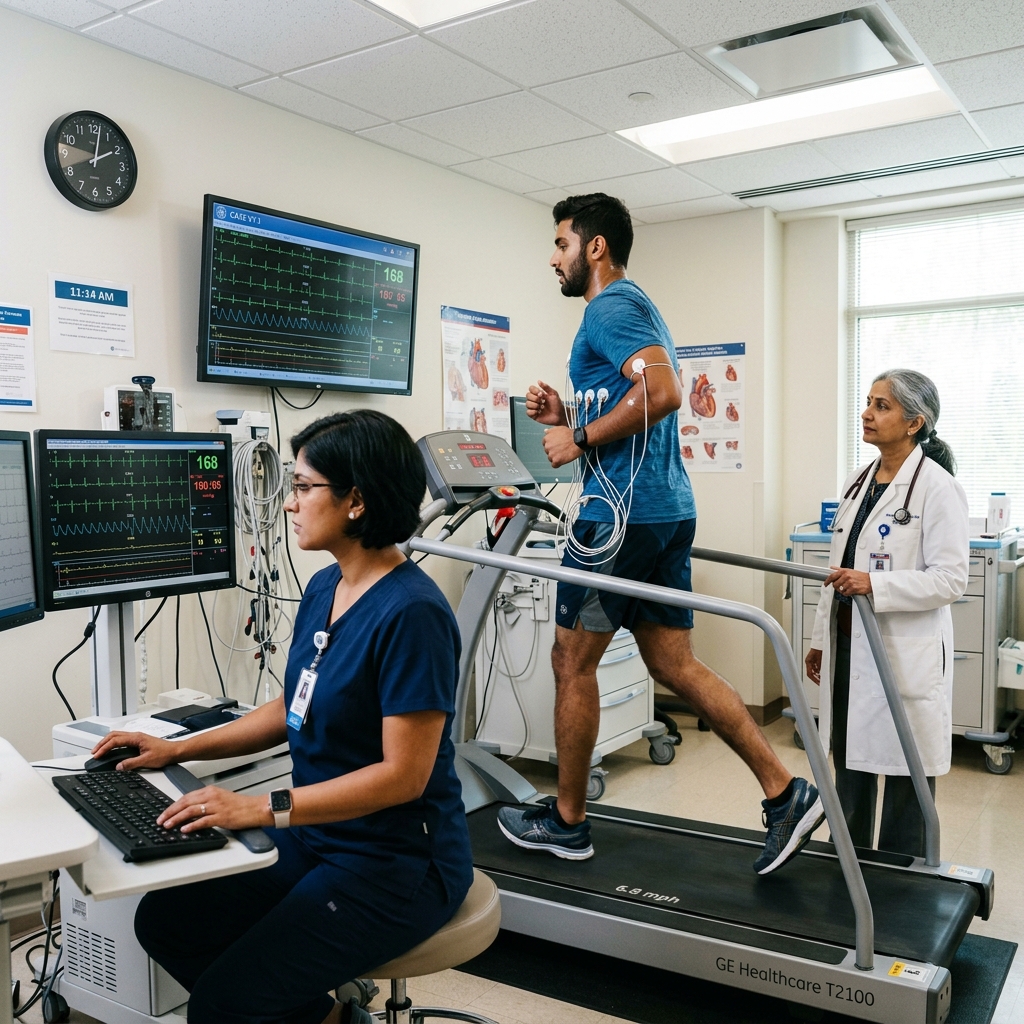
Treadmill Stress Test (TMT)
Exercise ECG to detect coronary artery disease and assess functional capacity.

24-Hour Holter Monitoring
Continuous ECG recording over 24–48 hours to detect intermittent arrhythmias and correlate with symptoms.

Ambulatory BP (ABPM)
24-hour automatic blood pressure monitoring that captures full diurnal BP profile.

Heart Failure
Chronic condition where the heart pumps inefficiently. Echo is essential for diagnosis and classification.
Ready to Consult Dr. Amit Singh?
Schedule a clinical consultation at Heartwise Cardiology Clinic, Sector 17, Vashi or Kokilaben Hospital, Navi Mumbai.
Heartwise in Vashi. Procedures at Kokilaben.
OPD consultations, diagnostics, and patient care at Heartwise Cardiology Clinic, Vashi. Interventional procedures performed at Kokilaben Hospital, Koperkhairne.
Heartwise Clinic — Vashi
Sector 17, Vashi
Comprehensive cardiac OPD, diagnostics and consultations at the Heartwise Cardiology Clinic in Sector 17, Vashi, Navi Mumbai.
Kokilaben Hospital — Koperkhairne
Koperkhairne, Navi Mumbai
Tertiary interventional cardiac procedures — angiography, angioplasty, TAVR, structural interventions and device implantation.
Palava City — Dombivli
Palava, Dombivli
Outreach consultation clinic serving Dombivli, Kalyan and surrounding Palava City catchment.
Deepisha Medical Centre — Ulwe
Ulwe, Navi Mumbai
Cardiac OPD consultation clinic serving Ulwe, Seawoods, Belapur and the Navi Mumbai International Airport catchment.
Serving All Sectors of Navi Mumbai & MMR
Patients routinely visit our Vashi clinic from across Navi Mumbai and the surrounding Mumbai Metropolitan Region.
“Beat Better. Live Wiser.”
Dr. Amit Singh, FACC
Consultant Interventional Cardiologist
Medical Disclaimer: This article has been written and reviewed by Dr. Amit Singh, FACC, for educational purposes only. It does not constitute personalised medical advice and should not be used as a substitute for a consultation with a qualified cardiologist. Individual clinical decisions must be made by a treating physician based on complete medical history and examination. If you are experiencing chest pain, breathlessness, or other cardiac symptoms, seek emergency medical care immediately.