
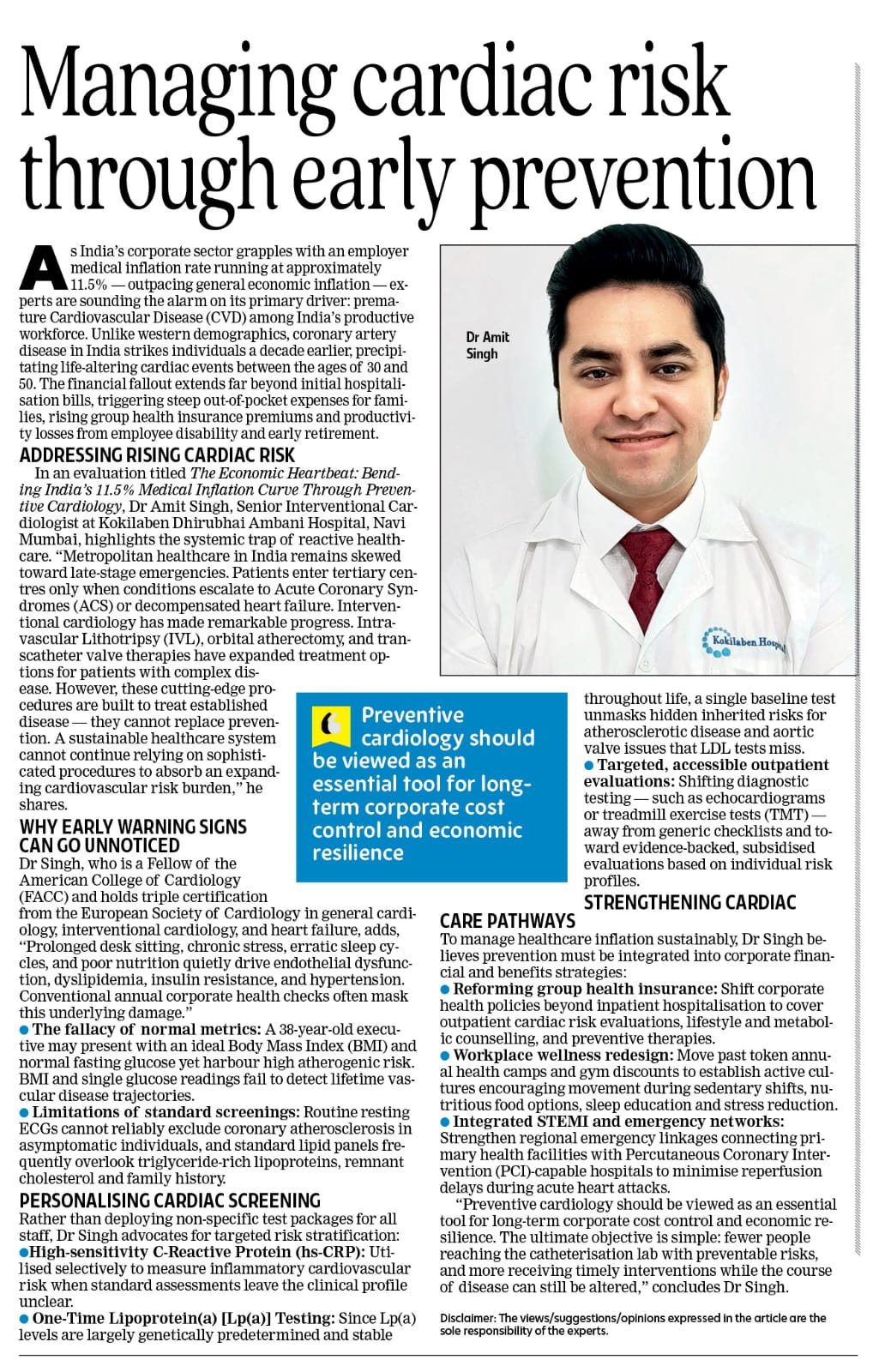
Heart disease is now a workforce issue
The feature opens with a problem every Indian employer recognises: corporate medical costs are rising by roughly 11.5% a year, well ahead of general inflation. A major driver is premature cardiovascular disease. In India, coronary artery disease tends to appear about a decade earlier than in Western populations, often between the ages of 30 and 50, so heart attacks strike people at the peak of their working lives. The cost reaches far beyond the hospital bill, into family savings, group insurance premiums and lost productivity.
Why treating late is not enough
Drawing on his evaluation, “The Economic Heartbeat: Bending India’s 11.5% Medical Inflation Curve Through Preventive Cardiology”, Dr. Singh describes how city healthcare remains tilted towards late-stage emergencies. Many patients reach a tertiary hospital only after an acute coronary syndrome or a decompensated heart failure episode. Interventional cardiology has advanced remarkably, with intravascular lithotripsy, orbital atherectomy and transcatheter valve therapies now treating complex disease, but, as he puts it, these procedures “are built to treat established disease — they cannot replace prevention.”
How cardiac risk hides behind normal reports
Long hours at a desk, chronic stress, irregular sleep and poor diet quietly damage blood vessels and drive high cholesterol, insulin resistance and high blood pressure. Dr. Singh cautions that a routine annual health check can make this look reassuring when it is not:
- Normal numbers can mislead. A person in their late thirties can have a healthy BMI and normal fasting sugar and still carry a high risk of artery-clogging plaque. Single readings say little about lifetime risk.
- Standard tests have limits. A resting ECG cannot rule out coronary artery disease in someone without symptoms, and a basic lipid profile can miss triglyceride-rich particles, remnant cholesterol and the weight of a family history.
Personalised screening instead of one-size packages
Rather than giving every employee the same test package, Dr. Singh advocates matching tests to each person’s risk profile:
- hs-CRP, used selectively. A high-sensitivity CRP test helps gauge inflammation-related cardiac risk when routine results leave the picture unclear.
- Lipoprotein(a), checked once. Lp(a) is largely inherited and stays stable through life, so a single test can reveal hidden inherited risk of artery disease and aortic valve problems that an LDL test misses.
- Targeted outpatient tests. Investigations such as an echocardiogram or treadmill test (TMT) are chosen for the individual, based on evidence and risk, not ticked off a generic checklist.
What employers and insurers can change
To make healthcare costs sustainable, Dr. Singh argues that prevention belongs inside corporate finance and benefits planning:
- Broader group insurance. Cover outpatient cardiac risk evaluations, lifestyle and metabolic counselling and preventive treatment, not only hospital admissions.
- Real workplace wellness. Go beyond a yearly health camp and gym discounts: encourage movement during long sitting hours, healthier food, better sleep and stress reduction.
- Faster heart attack care. Link primary health centres to hospitals that can perform emergency angioplasty, so patients having a heart attack reach treatment without delay.